
What Are the Most Common Electrical Code Violations Found in Florida Homes?
When our team at Performance Electrical Contracting Inc. inspects residential electrical systems across Florida, we regularly encounter hazards hidden behind closed panel doors and inside wall cavities. Many of these issues stems from a mix of aging equipment, well-intentioned DIY work, and environmental wear. Below are the most frequent violations cited during official building inspections and real estate evaluations.
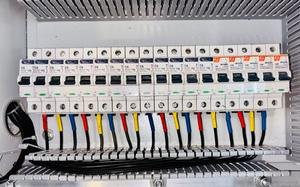
Outdated or Overcrowded Electrical Panels (FPE, Zinsco, and Double-Tapping)
Electrical panels are the heart of your home’s distribution system, but thousands of Florida homes still rely on outdated hardware that fails to meet modern safety thresholds.
- Federal Pacific Electric (FPE) Stab-Lok & Zinsco Panels: Manufactured primarily between the 1950s and 1980s, these panels have documented failure rates. FPE breakers frequently fail to trip during an overload or short circuit, while Zinsco breaker bus bars are notorious for melting and fusing together. Both present severe fire risks and lead to instant rejections during insurance 4-point inspections.
- Double-Tapped Breakers: Double-tapping occurs when an installer inserts two circuit wires into a single breaker terminal terminal that is only rated for one conductor. In Florida garages, where summer temperatures routinely exceed 100°F, continuous thermal expansion and contraction loosen these cramped connections, causing dangerous electrical arcing.
- Clearance Violations: The Florida Building Code (FBC) and National Electrical Code (NEC) mandate a clear working space around electrical panels measuring at least 36 inches deep, 30 inches wide, and 6.5 feet of vertical headroom. Stacking hurricane shutters, storage bins, or lawn equipment in front of your main breaker box violates code and prevents rapid power shutdown during an emergency.
If you suspect your electrical panel is overdue for an upgrade, review our guide on How to Tell When Your Home Needs an Electrical Safety Inspection.
Missing or Non-Compliant GFCI and AFCI Protection
The distinction between Ground-Fault Circuit Interrupter (GFCI) and Arc-Fault Circuit Interrupter (AFCI) devices is one of the most misunderstood areas of residential code compliance:
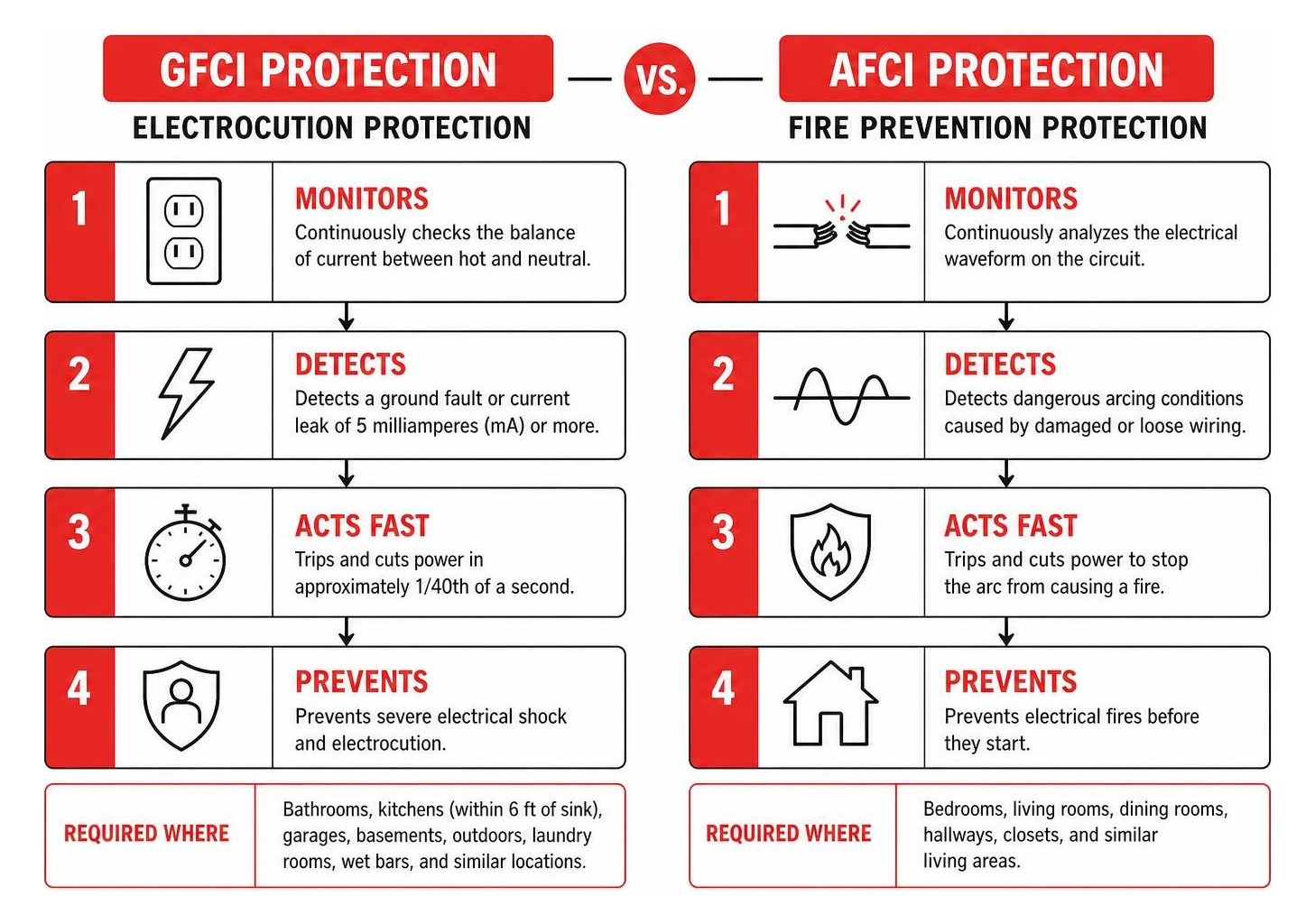
- GFCI Protection (NEC Article 210.8): GFCIs prevent severe electrical shock by monitoring the balance of current between hot and neutral wires. Under UL 943 standards, if a current leak exceeding 5 milliamperes (mA) is detected, the device cuts off power within approximately 1/40th of a second. Current Florida code requires GFCI protection on 15A and 20A, 125V receptacles in:
- Bathrooms and kitchens (specifically all countertop receptacles within 6 feet of a sink)
- Garages, unfinished basements, and crawl spaces
- Outdoor locations and boathouses
- Laundry rooms and wet bars
- Receptacles within 20 feet of a swimming pool, spa, or hot tub edge (NEC Article 680)
- AFCI Protection (NEC Article 210.12): While GFCIs protect people from electrocution, AFCIs protect structures from fires caused by arcing faults (damaged insulation, pinched wires, or loose connections). Under Florida’s adoption of recent NEC standards, AFCI protection is mandatory for branch circuits supplying outlets and devices in bedrooms, living rooms, dining rooms, family rooms, sunrooms, hallways, and closets.
To learn more about current safety mandates, read the statutory framework for AFCI and GFCI Protection Requirements in Florida and check out our detailed guide on Why You Should Upgrade Old Electrical Outlets and Switches.
Damaged Grounding Systems, PVC Plumbing Repairs, and Salt-Air Corrosion
Florida experiences more cloud-to-ground lightning strikes per square mile than any other state in the nation. This constant atmospheric activity places extraordinary demands on residential grounding and bonding infrastructure.
A common violation occurs when homeowners or plumbers repair old metal water lines with non-conductive PVC pipe. In many older Florida homes, the underground metallic water pipe served as a primary grounding electrode. Replacing a section of copper pipe with PVC severs this continuous metallic path, leaving the electrical system without a safe path to dissipate fault currents or lightning surges.
Furthermore, in coastal regions, airborne salt spray corrodes ground rods (which must measure at least 1/2 inch in diameter and 8 feet in length), ground clamps, and service entrance conductors. When corrosion destroys these bonds, high voltages can energize metal appliance frames, plumbing fixtures, and metal structural elements.
How Can You Spot Unpermitted Electrical Work and DIY Wiring Mistakes?
Unpermitted electrical work is the single most common trigger for code citations during Florida real estate sales and municipal inspections. Under Florida Statutes §553.84, property owners can face civil liability for maintaining non-compliant building systems that result in injury or property damage. Identifying unauthorized DIY additions before an official inspector arrives is essential.
Illegal Wiring Practices and Cable Routing Errors
When unqualified individuals add outlets, light fixtures, or subpanels, they frequently skip critical structural protections:
- Improper Wire Sizing: Matching wire gauge to circuit breaker amperage is basic electrical safety. Installing 14 AWG wire (rated for 15 amps) on a 20-amp circuit breaker creates a severe fire hazard because the wire will overheat long before the breaker trips.
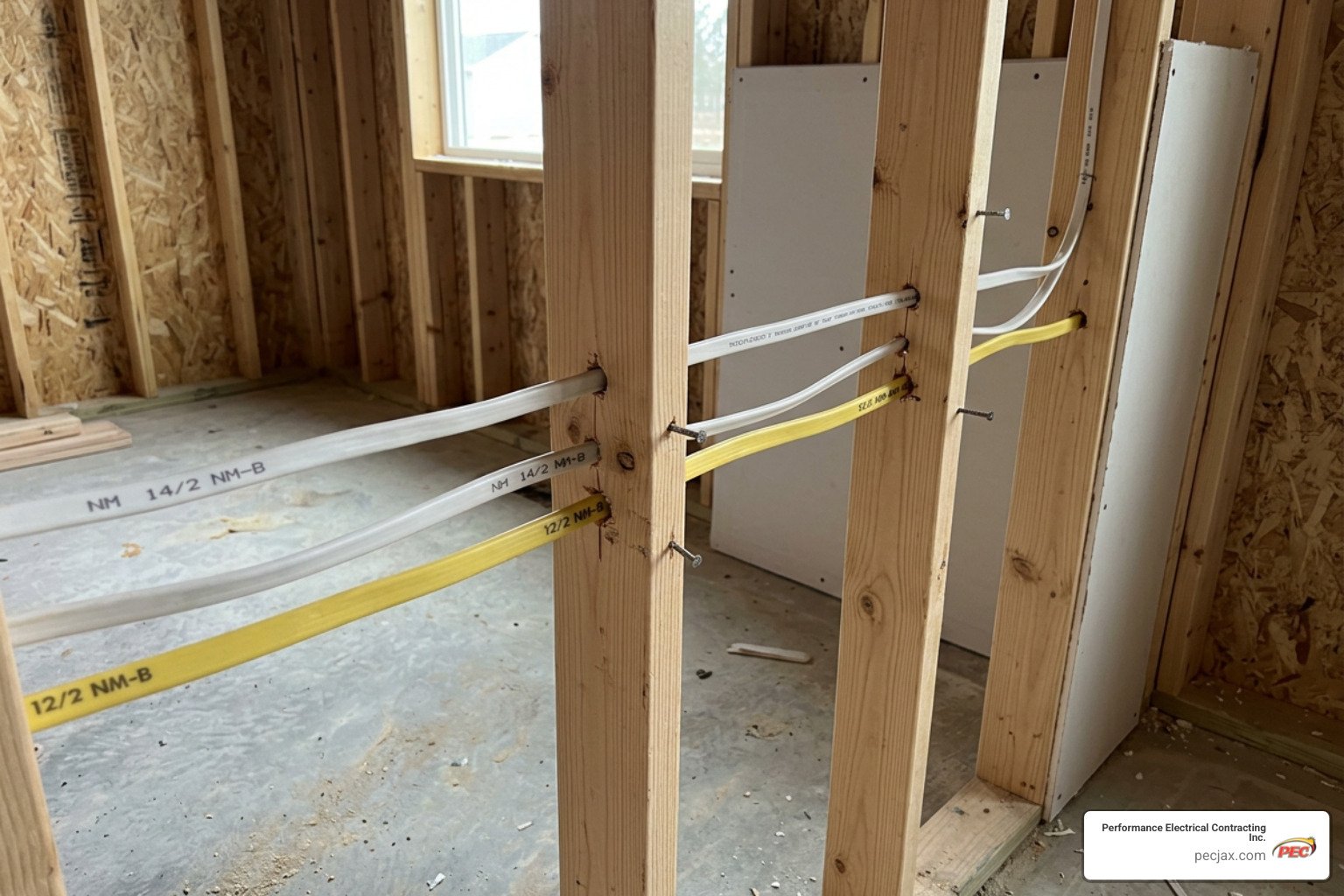
- Missing Protective Nail Plates: Non-metallic sheathed (NM) cable passing through wood framing studs must sit at least 1 ¼ inches from the edge of the stud. If the hole is drilled closer to the edge, a hardened steel nail plate must be installed to protect the cable from drywall screws and picture-hanging nails.
- Cable Support Intervals: Under the FBC and NEC, NM cable must be secured with approved staples within 12 inches of entering an outlet box or panel enclosure, and supported at maximum intervals of 4.5 feet along structural runs. Unsupported cables hanging across drop ceilings or attic joists violate code and stress connection terminals.
For technical specifications on residential wiring methods, refer to the 2023 Advanced Electrical Provisions for Builders.
Improper Outdoor Covers and Weatherproofing Violations
Florida’s torrential downpours require specialized outdoor electrical enclosures. Using incorrect covers outside is an immediate code red flag:
- Damp Locations vs. Wet Locations: A damp location (such as a fully covered front porch or screened patio) requires a weatherproof cover that seals when the cover is closed. A wet location (an outdoor wall or pool deck exposed to direct rainfall) requires a listed ‘extra-duty’ in-use cover (often called a bubble cover) that remains completely weatherproof even when an appliance cord is plugged in.
- Corroded Enclosures: Installing interior-rated metallic boxes, unsealed conduit, or non-weather-resistant receptacles outdoors allows salt-laden moisture to seep into live terminals, causing premature corrosion, short circuits, and ground faults.
Why Are Florida Homes Uniquely Prone to Severe Electrical Code Violations?
To understand why Florida properties suffer higher rates of electrical non-compliance than homes in other regions, we must evaluate how local environmental factors interact with residential wiring over time.
| Environmental & Historic Risk Factor | Physical Effect on Electrical Systems | Resulting Electrical Code Violation |
|---|---|---|
| High Atmospheric Humidity & Salt Air | Rapid oxidation of copper ground rods, service mast fittings, and panel bus bars | Corroded grounding electrodes, degraded main service connections |
| Nation-Leading Lightning Strikes | Frequent high-voltage surges traveling through residential service lines | Blown surge protectors, burned ground clamps, damaged circuit interrupters |
| Excessive Attic Temperatures (140°F+) | Thermal degradation and embrittlement of wire insulation over decades | Exposed conductors, short circuits, high fire hazard in branch wiring |
| High Garage Heat & Moisture Cycles | Expansion and contraction of metal terminals on breakers and switches | Loose screw connections, double-tapped breaker arcing, thermal failure |
| Pre-1973 Housing Stock Construction | Widespread installation of single-strand aluminum branch circuit wiring | Severe overheating at outlet terminations due to aluminum creep/corrosion |
| Frequent DIY Storm Renovations | Unpermitted generator interlocks, outdoor wiring, and subpanel additions | Illegal backfeeding, missing GFCI/AFCI protection, undersized wiring |
Subtropical Climate Stressors: Lightning, Severe Storms, and Extreme Heat
Florida’s harsh climate works against electrical infrastructure year-round. Unconditioned attics routinely reach 140°F or higher during summer months. Over 20 to 30 years, this intense heat bakes non-metallic cable sheathing, causing the plastic insulation to become brittle and crack when disturbed.
In attached garages, extreme daily temperature swings cause terminal screws on circuit breakers to back out over time. Loose connections increase electrical resistance, creating localized hotspots that melt insulation and ignite surrounding panel components.
Legacy Wiring Systems and Renovation Permit Triggers
Florida experienced massive housing booms during the 1960s and 1970s. As a result, many older residential neighborhoods contain legacy wiring systems that present modern compliance challenges:
- Pre-1973 Single-Strand Aluminum Wiring: Due to copper shortages during the Vietnam War era, builders widely used single-strand aluminum branch wiring. Aluminum expands and contracts far more than copper, leading to loose connections, oxidation, and elevated fire risks at standard switches and receptacles. Remediating aluminum wiring requires approved CO/ALR devices or professional pigtailing with copper using specialized connectors.
- Pre-1940s Knob-and-Tube Wiring: Found in historic districts across Florida, knob-and-tube lacks a dedicated grounding conductor and cannot handle modern appliance loads.
- Renovation Permit Triggers: Florida Building Code standards specify that when you pull a permit for a major renovation — such as a kitchen or bath remodel — the work scope often forces adjacent existing branch circuits to be upgraded to meet current AFCI and GFCI protection requirements.
When planning structural updates or additions, review our insights on The Importance of Electrical Capacity Planning for Growing Homes and Businesses.
What Are the 5 Ways to Identify Electrical Violations in Your Home?

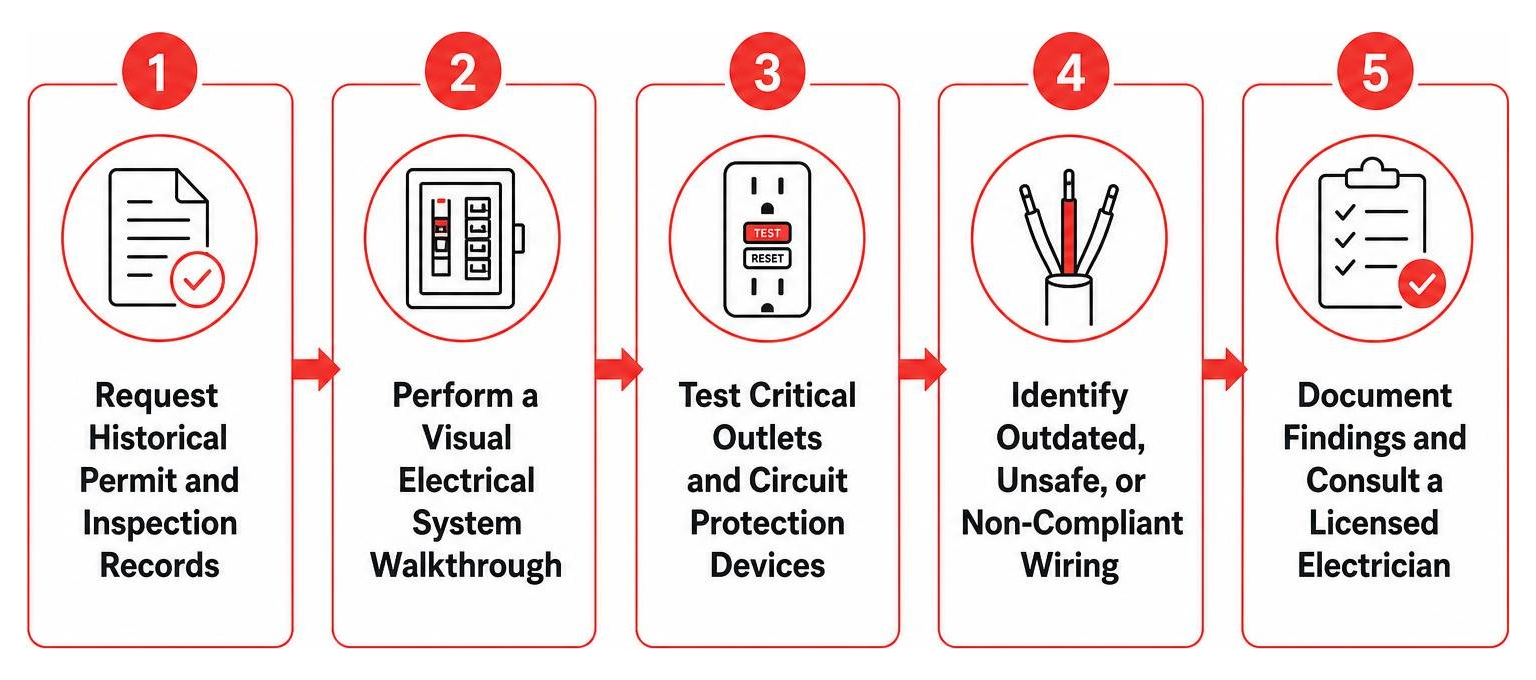
Whether you are preparing to list a home on the market, buying a new property, or managing an investment portfolio, evaluating electrical compliance requires a systematic approach. Below is our professional 5-step checklist for spotting potential code violations.
Step 1: Request Historical County Permit and Inspection Records
Before opening a panel door or pulling out a tester, examine your property’s public records.
- Contact your local municipal or county building department (or access their online permit portal).
- Cross-reference the official permit history against physical improvements on the property.
- Look specifically for unpermitted room additions, converted garages, outdoor kitchen wiring, swimming pool installations, or main panel service upgrades.
- If major electrical modifications exist without record of a final closed permit, those systems were likely installed without municipal plan review or field inspection, making code violations almost guaranteed.
Step 2: Perform a Visual Inspection of the Electrical Panel and Clearances
Open the outer door of your main service panel (without removing the protective dead-front cover) to conduct a visual assessment:
- Check the Brand: Look at the manufacturer label inside the door. If you see Federal Pacific Electric (FPE), Zinsco, Sylvania, or Challenger, consult a licensed electrical contractor immediately.
- Review the Directory: Ensure every breaker is clearly and permanently labeled (e.g., “Kitchen Countertop Receptacles” rather than generic notes like “Outlets”). Unlabeled breakers violate NEC requirements.
- Inspect for Physical Defects: Check for signs of rust along the bottom of the enclosure, moisture drops, charred plastic, or burn marks near breaker switches.
- Verify Working Space: Ensure a clear floor area 36 inches deep by 30 inches wide is maintained in front of the panel. Remove all storage bins, shelving, or outdoor equipment blocking access.
Step 3: Test All GFCI/AFCI Receptacles and Measure Proximity to Water
Inspect every room where moisture is present:
- Locate all outlets in bathrooms, kitchens, garages, laundry rooms, and outdoor walls.
- Press the “Test” button on each GFCI receptacle. The button should trip with a distinct snap, cutting power to the outlet face (and any downstream outlets on that circuit). Press “Reset” to restore power.
- If pressing “Test” fails to trip the mechanism, or if power remains active at the outlet face, the device has failed internal self-tests or is wired incorrectly.
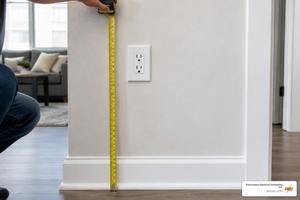
- Measure the distance from receptacle faceplates to the inside edge of sink basins, wet bars, and laundry tubs. Any standard 125V outlet located within 6 feet of a water source must have GFCI protection.
Step 4: Examine Outdoor Electrical Installations, Pool Wiring, and Weatherheads
Walk around the exterior perimeter of your home:
- Check Outdoor Receptacle Covers: Ensure all receptacles exposed to rain feature heavy-duty plastic or metallic ‘extra-duty’ in-use covers that close fully over attached power cords.
- Inspect Service Entrance Equipment: Look up at the overhead service mast and weatherhead where utility lines connect to your home. Check for loose conduit straps, cracked insulation on service cables, or rust on the meter socket enclosure.
- Evaluate Pool and Spa Equipment (NEC Article 680): Ensure pool pump motors, metal ladders, underwater lighting fixtures, and metal fence sections within 5 feet of the pool interior edge are properly connected to an equipotential bonding grid using solid copper conductors (minimum 8 AWG).
Step 5: Order a Comprehensive Master Electrician Safety Inspection
While visual checks uncover surface-level issues, concealed hazards require professional diagnostic tools. A standard insurance 4-point inspection is brief and only evaluates basic panel brand, service size, and visible wiring types.
A comprehensive code evaluation performed by a licensed contractor like Performance Electrical Contracting Inc. utilizes infrared thermal imaging to identify hidden electrical hotspots, digital ground-resistance meters to test earthing electrodes, and circuit analyzers to detect floating neutrals, voltage drop, and improper grounding loops behind walls.
What Are the Financial and Legal Penalties for Florida Code Violations?
Ignoring electrical code compliance in Florida carries steep statutory and administrative penalties. Local building departments, code enforcement boards, and insurance underwriters possess sweeping legal authority to enforce compliance.
Code Enforcement Fines, Stop-Work Orders, and Statutory Liens
Under Florida Statute §162.09, municipal code enforcement boards hold the authority to levy significant daily fines against non-compliant property owners:
- Initial Violations: Up to $250 per day for first-time citations.
- Repeat Violations: Up to $500 per day for repeat offenses.
- Irreparable/Irreversible Harm: Fines up to $5,000 per violation for hazardous conditions that pose immediate public safety threats.
- Large Municipalities: In jurisdictions with populations exceeding 50,000, fines can legally reach up to $15,000 per violation per day.
Under Florida Building Code §110.7, local inspectors who discover active unpermitted electrical work will issue an immediate Stop-Work Order. Continuing work after a stop-work order is posted can lead to misdemeanor criminal charges. Furthermore, accrued code enforcement fines are recorded in county public records as statutory tax liens against the property, clouding the title and preventing any refinance or sale until paid in full.
Real Estate Closing Delays, Insurance Cancellations, and Licensing Penalties
Beyond municipal fines, code violations impact property transactions and insurance eligibility:
- Insurance Non-Renewal & Denial: Following major storm seasons, Florida home insurance carriers scrutinize 4-point inspection reports. Uncertified FPE/Zinsco panels, double-tapped breakers, single-strand aluminum wiring, or missing GFCI protection often result in immediate policy cancellation or coverage denial until professional remediation is completed.
- Real Estate Disclosure Liability: Under Florida civil contract law (such as the Johnson v. Davis precedent), sellers must disclose known latent defects that materially affect property value. Concealing unpermitted electrical work exposes sellers to post-closing lawsuits.
- Contractor Licensing Disciplines: Under Florida Statutes Chapter 489, performing electrical contracting without a valid license or pulling owner-builder permits to execute work for commercial gain can result in Florida Construction Industry Licensing Board (CILB) fines reaching up to $10,000 per violation.
To understand the regulatory standards enforced across Florida, read about The Industry Standards That Power Commercial Electrical Installation.
Frequently Asked Questions About Florida Electrical Code Violations
Can a homeowner sell a Florida property with unresolved electrical code violations?
Yes, a property can technically be sold with code violations, but doing so creates significant legal and financial hurdles. Active code enforcement violations and municipal liens are material facts that must be disclosed in writing during real estate contract negotiations, and any outstanding financial liens must be cleared or escrowed before closing.
In addition, buyer mortgage lenders typically refuse loan origination, and Florida property insurance carriers will deny mandatory coverage if severe electrical hazards (such as Federal Pacific panels or active aluminum wiring) are identified on 4-point inspection reports.
Are older Florida homes required to retroactively meet current electrical codes?
No. Under the Florida Building Code and NEC Article 80, existing residential electrical installations that met code when originally permitted are generally grandfathered in and do not require retroactive upgrades simply because a new code edition is published.
However, grandfathered status is voided if the local building official determines the existing system represents an immediate life-safety hazard, or if new permitted remodeling work (such as a kitchen or room addition) extends existing branch circuits, triggering mandatory AFCI/GFCI retrofits across adjacent wiring under current FBC guidelines.
What is the difference between a 4-point inspection and a code compliance inspection?
A 4-point inspection is a narrow, surface-level assessment required by insurance carriers for Florida homes typically 20 years or older. It evaluates four basic systems (roof, plumbing, HVAC, and electrical) to establish general insurer risk, focusing primarily on panel brand, service amperage, and visible wiring types.
A code compliance inspection performed by a licensed master electrician is a deep diagnostic evaluation. It tests entire distribution networks, panel thermal signatures, grounding electrode resistance, box fill calculations, device polarity, and precise NEC/FBC section compliance across all interior and exterior circuits.
What Are the Final Steps to Resolve Electrical Violations in Florida?
Resolving electrical code violations requires a methodical approach to ensure occupant safety, legal protection, and long-term asset value:
- Obtain Public Permit Histories: Always verify past work before starting new projects.
- Perform Routine Visual and Device Checks: Test GFCI and AFCI outlets monthly, clear panel access paths, and look for signs of corrosion on outdoor equipment.
- Hire Licensed Professionals: Never rely on unpermitted DIY work or uncertified contractors for electrical repairs.
At Performance Electrical Contracting Inc., we deliver expert electrical installation, maintenance, code compliance evaluations, and complete system remediation for residential, commercial, multifamily, and industrial properties across Jacksonville and the Southeast U.S. Our team works directly with property owners, general contractors, and local building departments to ensure every project is completed safely, legally, on time, and within budget.
If you suspect code violations, face insurance cancellation notices, or require a comprehensive safety evaluation, contact Performance Electrical Contracting Inc. today to schedule a professional inspection with our certified team.